

dr Namrata Joshi
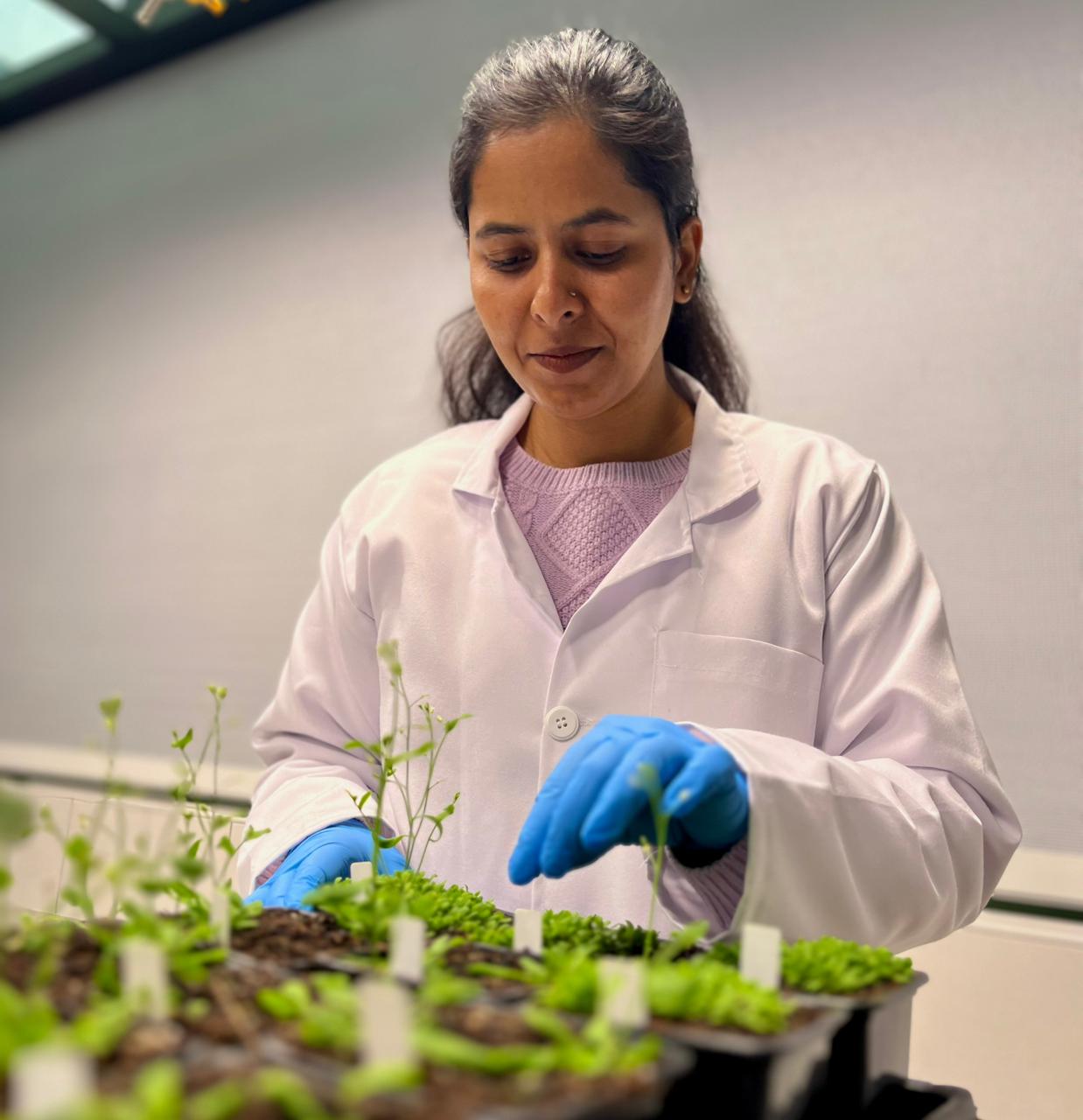
Dr. Namrata Joshi serves as an adjunct researcher advancing the concept of Dynamic Microbial Fertilizers, designed to enhance soil regeneration and crop productivity through microbial strain rotation. Building upon her PhD work in waste biovalorization and composting, she continues to explore composting processes while developing innovative microbial biopreparations and biopesticides that foster plant growth and support circular, sustainable agriculture.
Scientific interests
- Waste valorization
- Environmental microbiology
- Composting and soil bioregeneration
- Microbial biopreparations and biopesticides for sustainable crop production
Publications
2024
Vaccaro, Francesca; Passeri, Iacopo; Ajijah, Nur; Bettini, Priscilla; Courty, Pierre Emmanuel; Dębiec-Andrzejewska, Klaudia; Joshi, Namrata; Kowalewska, Łucja; Stasiuk, Robert; Musiałowski, Marcin; Pranaw, Kumar; Mengoni, Alessio
Genotype-by-genotype interkingdom cross-talk between symbiotic nitrogen fixing Sinorhizobium meliloti strains and Trichoderma species Journal Article
In: Microbiological Research, vol. 285, 2024, ISSN: 0944-5013.
@article{Vaccaro2024c,

title = {Genotype-by-genotype interkingdom cross-talk between symbiotic nitrogen fixing Sinorhizobium meliloti strains and Trichoderma species},

author = {Francesca Vaccaro and Iacopo Passeri and Nur Ajijah and Priscilla Bettini and Pierre Emmanuel Courty and Klaudia Dębiec-Andrzejewska and Namrata Joshi and Łucja Kowalewska and Robert Stasiuk and Marcin Musiałowski and Kumar Pranaw and Alessio Mengoni},

doi = {10.1016/j.micres.2024.127768},

issn = {0944-5013},

year  = {2024},

date = {2024-08-00},

journal = {Microbiological Research},

volume = {285},

publisher = {Elsevier BV},

keywords = {},

pubstate = {published},

tppubtype = {article}

}
Joshi, Namrata; Grewal, Jasneet; Stasiuk, Robert; Drewniak, Lukasz; Pranaw, Kumar
Unveiling the secretome of Penicillium fuscoglaucum JAM-1 for efficient dual substrate degradation and waste valorization Journal Article
In: Biomass Conversion and Biorefinery, pp. 1-12, 2024, ISSN: 21906823.
@article{Joshi2024b,

title = {Unveiling the secretome of Penicillium fuscoglaucum JAM-1 for efficient dual substrate degradation and waste valorization},

author = {Namrata Joshi and Jasneet Grewal and Robert Stasiuk and Lukasz Drewniak and Kumar Pranaw},

url = {https://link.springer.com/article/10.1007/s13399-024-05809-6},

doi = {10.1007/S13399-024-05809-6/FIGURES/6},

issn = {21906823},

year  = {2024},

date = {2024-01-01},

journal = {Biomass Conversion and Biorefinery},

pages = {1-12},

publisher = {Springer Science and Business Media Deutschland GmbH},

abstract = {In the pursuit of cost-effective and superior enzymes crucial for the efficient hydrolysis of diverse lignocellulosic biomasses, filamentous fungi have emerged as key candidates for bioprospecting endeavors. In our exploration for potent lignocellulosic biomass degraders, we have identified a strain of Penicillium fuscoglaucum JAM-1, showcasing multipurpose hydrolase capabilities in its secretome. During fermentation, P. fuscoglaucum JAM-1 effectively utilized rapeseed cake (RSC), resulting in improved enzymatic activities, including xylanase (612 U/gds), β-glucosidase (264 U/gds), endoglucanase (102 U/gds), FPase (21.3 U/gds), and exo-polygalacturonase (49.17 U/gds), as compared to pine sawdust (PSD). Secretome profiling revealed a protein abundance totaling 435 and 120 proteins during RSC and PSD utilization, respectively. The major component of carbohydrate-active enzymes (CAZymes) consists of cellulose-degrading proteins, including endoglucanases (GH5, GH7), β-glucosidases (GH1, GH3, GH17), and cellobiohydrolases (GH6, GH7). Correspondingly, hemicellulose-degrading enzymes were present, encompassing endo-1,4-xylanase (GH10), α/β-galactosidase (GH27, GH35, GH36), α/β-mannosidases (GH38, GH2, GH47, GH5), and α-l-arabinofuranosidase (GH43, GH62, GH51, GH54) and carbohydrate-active auxiliary activities enzymes, such as AA9 (formerly known as GH61) lytic polysaccharide monooxygenase (LPMO). Upon application to fruit waste, the crude enzyme demonstrated higher saccharification potential compared to commercial cellulase (Cellic CTec2). Specifically, the crude enzyme yielded 565 mg/g of reducing sugar within 72 h, outperforming Cellic CTec2, which yielded 352 mg/g under identical conditions. A comprehensive comparative analysis of enzyme workings, activities, and secretome profiling underscores P. fuscoglaucum JAM-1 as a potent cellulase producer, showcasing its potential to boost lignocellulose biodegradation. These findings highlight the practical applications of the P. fuscoglaucum JAM-1 in various industrial processes, suggesting its role as a valuable candidate for further exploration and exploitation in biotechnological applications. Graphical abstract: (Figure presented.)},

keywords = {},

pubstate = {published},

tppubtype = {article}

}
Joshi, Namrata; Grewal, Jasneet; Drewniak, Lukasz; Pranaw, Kumar
Bioprospecting CAZymes repertoire of Aspergillus fumigatus for eco-friendly value-added transformations of agro-forest biomass Journal Article
In: Biotechnology for Biofuels and Bioproducts, vol. 17, iss. 1, pp. 1-13, 2024, ISSN: 27313654.
@article{Joshi2024c,

title = {Bioprospecting CAZymes repertoire of Aspergillus fumigatus for eco-friendly value-added transformations of agro-forest biomass},

author = {Namrata Joshi and Jasneet Grewal and Lukasz Drewniak and Kumar Pranaw},

url = {https://biotechnologyforbiofuels.biomedcentral.com/articles/10.1186/s13068-023-02453-6 http://creativecommons.org/publicdomain/zero/1.0/},

doi = {10.1186/S13068-023-02453-6/TABLES/3},

issn = {27313654},

year  = {2024},

date = {2024-01-01},

journal = {Biotechnology for Biofuels and Bioproducts},

volume = {17},

issue = {1},

pages = {1-13},

publisher = {BioMed Central Ltd},

abstract = {Background: Valorizing waste residues is crucial to reaching sustainable development goals and shifting from a linear fossil-based economy to a circular economy. Fungal cell factories, due to their versatility and robustness, are instrumental in driving the bio-transformation of waste residues. The present work isolated a potent strain, i.e., Aspergillus fumigatus (ZS_AF), from an ancient Złoty Stok gold mine, which showcased distinctive capabilities for efficient hydrolytic enzyme production from lignocellulosic wastes. Results: The present study optimized hydrolytic enzyme production (cellulases, xylanases, and β-glucosidases) from pine sawdust (PSD) via solid-state fermentation using Aspergillus fumigatus (ZS_AF). The optimization, using response surface methodology (RSM), produced a twofold increase with maximal yields of 119.41 IU/gds for CMCase, 1232.23 IU/gds for xylanase, 63.19 IU/gds for β-glucosidase, and 31.08 IU/gds for FPase. The secretome profiling validated the pivotal role of carbohydrate-active enzymes (CAZymes) and auxiliary enzymes in biomass valorization. A total of 77% of carbohydrate-active enzymes (CAZymes) were constituted by glycoside hydrolases (66%), carbohydrate esterases (9%), auxiliary activities (3%), and polysaccharide lyases (3%). The saccharification of pretreated wheat straw and PSD generated high reducing sugar yields of 675.36 mg/g and 410.15 mg/g, respectively. Conclusion: These findings highlight the significance of an efficient, synergistic, and cost-effective arsenal of fungal enzymes for lignocellulosic waste valorization and their potential to contribute to waste-to-wealth creation through solid-waste management. The utilization of Aspergillus fumigatus (ZS_AF) from an unconventional origin and optimization strategies embodies an innovative approach that holds the potential to propel current waste valorization methods forward, directing the paradigm toward improved efficiency and sustainability.},

keywords = {},

pubstate = {published},

tppubtype = {article}

}
2023
Joshi, Namrata; Grewal, Jasneet; Matusik, Jakub; Drewniak, Lukasz; Pranaw, Kumar
Faujasite Na-X zeolite as a novel carrier for cellulase immobilization and application in biomass saccharification Journal Article
In: Biochemical Engineering Journal, vol. 198, pp. 109017, 2023, ISSN: 1369-703X.
@article{JOSHI2023109017,

title = {Faujasite Na-X zeolite as a novel carrier for cellulase immobilization and application in biomass saccharification},

author = {Namrata Joshi and Jasneet Grewal and Jakub Matusik and Lukasz Drewniak and Kumar Pranaw},

url = {https://www.sciencedirect.com/science/article/pii/S1369703X23002127},

doi = {https://doi.org/10.1016/j.bej.2023.109017},

issn = {1369-703X},

year  = {2023},

date = {2023-01-01},

journal = {Biochemical Engineering Journal},

volume = {198},

pages = {109017},

abstract = {As a sustainable and eco-friendly alternative to conventional chemical catalysis, the immobilization of enzymes has been advocated as an attractive strategy to offset the limitations of single-use and rapid loss of activity. The present study aimed to investigate an inert inorganic material, i.e. Na-X zeolite derived from fly ash as a solid carrier for the immobilization of cellulase, a pivotal enzyme for biomass valorization. The cellulase enzyme (Cellic CTec2) was covalently immobilized over Na-X zeolite using glutaraldehyde as a cross-linking agent with immobilization efficiency and yield of 73% and 77%, respectively. The immobilized cellulase exhibited better pH stability (5.0–9.0), temperature optima of 60 °C, and a three-fold half-life (t1/2) enhancement at 60 °C than its free counterpart. The immobilized preparation retained > 80% residual activity after 5 repeated cycles of usage and had enhanced shelf life, as reflected by good storage stability at both 4 °C and 22 °C after 4 weeks of incubation. The immobilized formulation was utilized to saccharify alkaline pretreated wheat straw to demonstrate its potential for biorefinery applications, and structural deconstruction was validated by SEM, XRD, and FTIR analysis. The high reducing sugar yield for two consecutive cycles confirms its suitability for continuous operation in hydrolyzing lignocellulosic substrates.},

keywords = {},

pubstate = {published},

tppubtype = {article}

}
2022
Grewal, Jasneet; Woła̧cewicz, Mikołaj; Pyter, Weronika; Joshi, Namrata; Drewniak, Lukasz; Pranaw, Kumar
Colorful Treasure From Agro-Industrial Wastes: A Sustainable Chassis for Microbial Pigment Production Journal Article
In: Frontiers in Microbiology, vol. Volume 13 - 2022, 2022, ISSN: 1664-302X.
@article{10.3389/fmicb.2022.832918,

title = {Colorful Treasure From Agro-Industrial Wastes: A Sustainable Chassis for Microbial Pigment Production},

author = {Jasneet Grewal and Mikołaj Woła̧cewicz and Weronika Pyter and Namrata Joshi and Lukasz Drewniak and Kumar Pranaw},

url = {https://www.frontiersin.org/journals/microbiology/articles/10.3389/fmicb.2022.832918},

doi = {10.3389/fmicb.2022.832918},

issn = {1664-302X},

year  = {2022},

date = {2022-01-01},

journal = {Frontiers in Microbiology},

volume = {Volume 13 - 2022},

abstract = {Colors with their attractive appeal have been an integral part of human lives and the easy cascade of chemical catalysis enables fast, bulk production of these synthetic colorants with low costs. However, the resulting hazardous impacts on the environment and human health has stimulated an interest in natural pigments as a safe and ecologically clean alternative. Amidst sources of natural producers, the microbes with their diversity, ease of all-season production and peculiar bioactivities are attractive entities for industrial production of these marketable natural colorants. Further, in line with circular bioeconomy and environmentally clean technologies, the use of agro-industrial wastes as feedstocks for carrying out the microbial transformations paves way for sustainable and cost-effective production of these valuable secondary metabolites with simultaneous waste management. The present review aims to comprehensively cover the current green workflow of microbial colorant production by encompassing the potency of waste feedstocks and fermentation technologies. The commercially important pigments viz. astaxanthin, prodigiosin, canthaxanthin, lycopene and β-carotene produced by native and engineered bacterial, fungal or yeast strains have been elaborately discussed with their versatile applications in food, pharmaceuticals, textiles, cosmetics etc. The limitations and their economic viability to meet the future market demands have been envisaged. The most recent advances in various molecular approaches to develop engineered microbiological systems for enhanced pigment production have been included to provide new perspectives to this burgeoning field of research.},

keywords = {},

pubstate = {published},

tppubtype = {article}

}